What is GEO (Generative Engine Optimization)? Boost Your Business in The Era of AI

AI-driven search is rapidly changing how customers discover brands online. Platforms powered by large language models (LLMs), such as ChatGPT and Gemini, are now becoming primary research channels for users evaluating products and services.
This shift means that businesses can no longer rely solely on traditional rankings to capture visibility and traffic. If your brand, products, or services are not structured and optimized for AI interpretation, they are less likely to be cited in these responses, resulting in missed exposure to high-intent audiences and a loss of potential qualified leads and revenue opportunities. This is why Generative Engine Optimization (GEO) has become a critical strategy for businesses seeking to capitalize on this emerging opportunity.
What is Generative Engine Optimization (GEO)?
AI systems follow structured patterns when processing and generating information for users. Generative Engine Optimization (GEO) is the process of optimizing digital content so that it can be easily discovered, understood, and cited by AI-powered search and answer platforms. GEO focuses on helping content, such as a business’s brand, products, and services, appear directly within AI-generated responses.
These responses are produced by large language models (LLMs) such as ChatGPT and Gemini. LLMs can anticipate follow-up questions and chain related queries to build more complete answers. For businesses, this means a single search can quickly evolve into multiple intent-driven questions, such as comparisons, pricing, features, and reviews. If your content is properly structured with GEO, your brand has more opportunities to appear throughout this extended decision-making journey, increasing conversion potential across AI-driven search experiences.
How GEO Differs from Traditional SEO
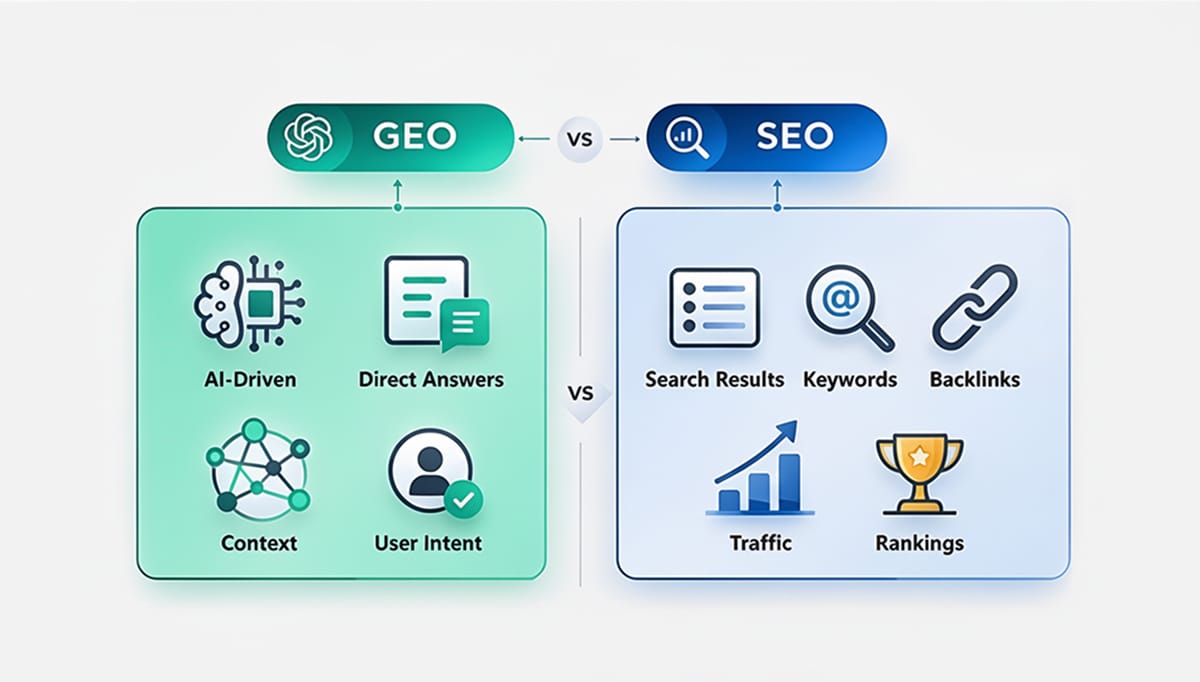
To understand the differences between GEO and SEO, it helps to know what Search Engine Optimization (SEO) means:
SEO:
- Improves a website’s visibility in search engine results pages (SERPs) through strategies like keyword optimization, backlinks, site structure, and meta information.
- Aims to attract organic traffic by ranking higher in Google, Bing, or other search engines.
Conversely, GEO:
- Optimizes content specifically for AI-driven platforms powered by LLMs
- Aims to have content discovered, accurately interpreted, and cited directly in AI-generated responses.
Here is a simple table that sums up their differences:
| Feature | Traditional SEO | Generative Engine Optimization (GEO) |
| Goal | Rank higher in search engine results | Appear in AI-generated responses |
| Focus | Keywords, backlinks, meta tags, technical SEO | Clear structure, factual accuracy, authoritative content |
| Traffic Type | Organic clicks from SERPs | Clicks from AI platforms or cited answers |
| User Mindset | Browsing, exploring options | Ready to act, already researched decisions |
| Why it Matters | Rankings, impressions, clicks | Citations in AI responses, conversions from GEO clicks |
Conversion rates from GEO-driven traffic are often higher because users interacting with AI-powered search typically have clearer intent. By the time they encounter AI-generated answers, they are usually further along in the decision-making process, having already explored their options and narrowed their needs.
For businesses, this creates a powerful advantage: when your brand appears within these AI-generated results, it reinforces credibility at a critical moment in the customer journey. This makes potential customers more likely to engage with your brand and ultimately move forward with a purchase.
What are The Benefits of GEO?
- Growth in Brand Visibility: GEO helps your content appear in AI-generated responses, increasing exposure and putting your brand directly in front of audiences at the right moment. By consistently appearing in these trusted AI answers, you not only build credibility with the algorithm but also earn the trust of the people relying on it.
- Increased Authority: As AI platforms cite your content more, it builds a compounding effect, strengthening your semantic presence (how AI understands and associates your expertise), which leads to even more references over time.
- Competitive Advantage: GEO can position brands as trusted sources within AI platforms, helping them stand out from similar competitors in their industry.
- Topic Cluster Domination: GEO allows businesses to optimize for entire topics, improving the chances of being referenced across related queries. This means you no longer have to compete solely for specific keywords and can utilize uncovered keywords that competitors may have missed.
- Improved Local Search: Optimizing for AI-driven platforms can also boost visibility for location-specific searches, helping businesses connect with nearby users who are ready to take action, transforming online discovery into real-world foot traffic and conversions.
How is GEO Implemented?
1. Location of Online Presence
GEO goes beyond traditional SEO, which primarily focuses on optimizing your own website and properties. For GEO, content must also be strategically placed in trusted external sources such as industry publications, review platforms, discussion threads, and forums. A consistent presence across these sources increases the likelihood that AI systems will find and reference your content more, strengthening your visibility and authority.
2. Structure of Content
Well-structured content is crucial for GEO. Organize information clearly with headings, bullet points, and concise explanations. Each paragraph should be self-contained so that AI systems can extract and reuse answers without misinterpretation. Place answers early in the text, use clear headings to indicate which question is being answered, and ensure that explanations are precise.
Unlike traditional SEO, which prioritizes comprehensiveness, GEO emphasizes clarity, structure, and ease of interpretation for AI. Technical elements such as schema markup further help AI understand the type of content, the relationships between different pieces of information, and how it relates to user queries.
3. Technical Optimization
Ensure your website and content are technically optimized for AI indexing. This includes proper metadata, schema markup, fast-loading pages, and mobile-friendly design, all of which make it easier for AI platforms to interpret and thus rank your content.
4. Reputation Building
Establish authority and trust by consistently providing accurate, high-quality content. The more AI platforms and other reputable sources cite your content, the stronger your semantic presence becomes in the digital ecosystem. Over time, this reinforces your brand as a recognized expert not only online, but also in the perception of your target audience.
A rule of thumb is to follow Google’s E-E-A-T Standards, which focus on Experience, Expertise, Authoritativeness, and Trustworthiness, ensuring your content demonstrates credibility and reliability to both users and AI systems.
Performance Metrics You Should Track in GEO
Measuring GEO performance can be trickier than traditional SEO because the typical user path is different. With SEO, clicks to your website can be traced directly to traffic and revenue. With GEO, users may not click through immediately, and analytics often won’t indicate that your content was referenced in an AI-generated response.
Despite this, there are key metrics you can track to understand your GEO ROI:
- Citation Frequency: Track how often AI platforms mention your brand or content when answering user queries. Frequent citations indicate growing authority and visibility.
- Share of Voice: Measure your mention rate in AI responses compared to competitors. This shows your relative presence and influence in AI-driven search.
- Context Tracking: Analyze the types of questions and topics where your content is being referenced. This helps you understand how AI interprets your content and which areas are most effective.
- Sentiment: Monitor the perception of your mentions. More citations don’t always equal positive outcomes, so understanding sentiment ensures your brand reputation is being managed effectively.
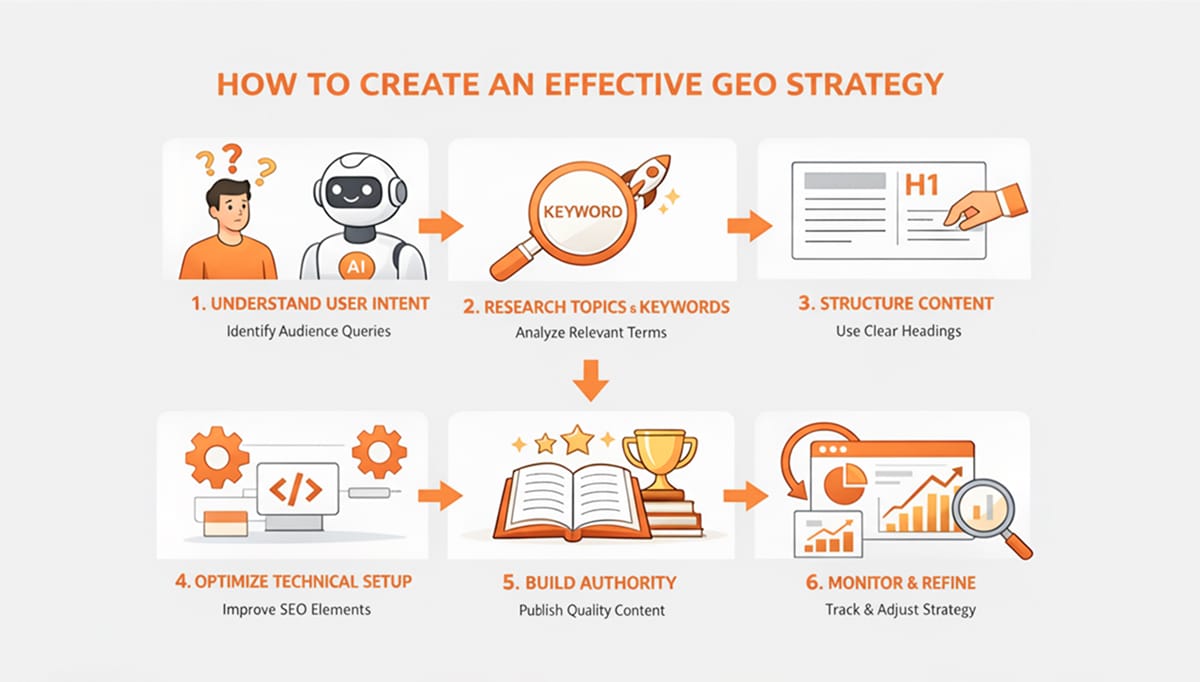
How to Create an Effective GEO Strategy?
- Understand User Intent and AI Behavior: Start by identifying what users are looking for and how AI systems interpret and extract information. Consider the types of questions your audience asks and the context AI needs to provide accurate answers. This is important as it controls the perception of your business digitally and in real-life.
- Research Relevant Topics and Keywords: Identify the topics and phrases your audience is searching for. Balance search volume with competition, and focus on terms that AI is likely to reference in responses. By aligning your content with real user intent, you directly address your audience’s problems and needs, positioning your brand as a trustworthy provider of solutions.
- Structure Content Clearly: Organize your content with concise paragraphs, descriptive headings, bullet points, and tables. Ensure each section can stand alone so AI can extract answers without misinterpretation. This balance of well-structured and high-quality content improves readability for users while making your information easier for AI platforms to process and surface your brand in their searches.
- Optimize Technical Elements: Use schema markup, metadata, and proper site architecture to help AI systems recognize entities, understand relationships, and interpret context accurately.
- Build Authority and Reputation: Publish high-quality, accurate content consistently. Encourage citations from reputable sources to strengthen your semantic presence. This increases the chances of your business being featured in AI-generated searches, boosting perceived authority.
- Monitor and Refine: Track how your content is being referenced by AI, identify gaps, and adjust your strategy over time. Continually improving your content and structure will help maintain and grow visibility in AI-driven search. This helps your brand continuously adapt to changing user intents and AI algorithms, helping you stay as competitive as possible.
Other Frequently Asked Questions (FAQs) About GEO
1. Which types of content are most likely to be included in AI-generated answers?
AI favors content that is clear, accurate, relevant, and well-structured. This means providing valuable information, using relevant keywords, breaking text into short, digestible paragraphs, and including descriptive headings, lists, or tables to make content easy for both humans and AI to read and understand.
2. Does AI search only benefit big brands, or can smaller businesses compete with GEO as well?
While large brands may have a visibility advantage, GEO allows smaller or niche businesses to compete effectively. By positioning yourself as an expert in your niche and producing high-quality, structured content, AI platforms can reference your work, helping you gain authority and visibility even without being a household name.
3. If AEO and GEO both involve AI, what are their differences?
- Answer Engine Optimization (AEO) focuses on optimizing content specifically to appear in answer boxes or quick responses on traditional search engines, like Google’s featured snippets.
- Generative Engine Optimization (GEO) targets AI-driven platforms and large language models (LLMs) that generate conversational responses.
While both strategies aim to increase visibility in AI-assisted search, GEO emphasizes content discoverability, semantic clarity, and structured information so that AI can reference, synthesize, and cite your content as authoritative sources.
Conclusion
While SEO helps you rank higher in traditional search results, GEO ensures your content is discoverable and cited in AI-generated responses. Combining both these strategies will help position your brand as an authoritative and trustworthy source, giving you a competitive advantage and maximizing your visibility across multiple digital channels.
Contact us today to partner with our SEO and GEO experts who can help your business optimize content, build authority, and connect with your audience across search engines and AI-driven platforms.