What is AI Visibility? A Business Guide for AI & SEO
Introduction
Search is no longer just a list of links. People can ask ChatGPT, Perplexity, or Gemini a full question and get a summarised answer, while Google can now show AI-generated answers directly in search. As more people turn to AI for answers, AI visibility becomes a powerful way for businesses to be found online.
This is different from simply ranking for keywords. SEO fundamentals still matter, but AI visibility also looks at how AI systems understand and represent your business, whether they mention or cite you, and how you compare with competitors. This guide explains what AI visibility means, why it matters, and how approaches such as AEO and GEO can help improve your presence in AI search.
What Is AI Visibility?
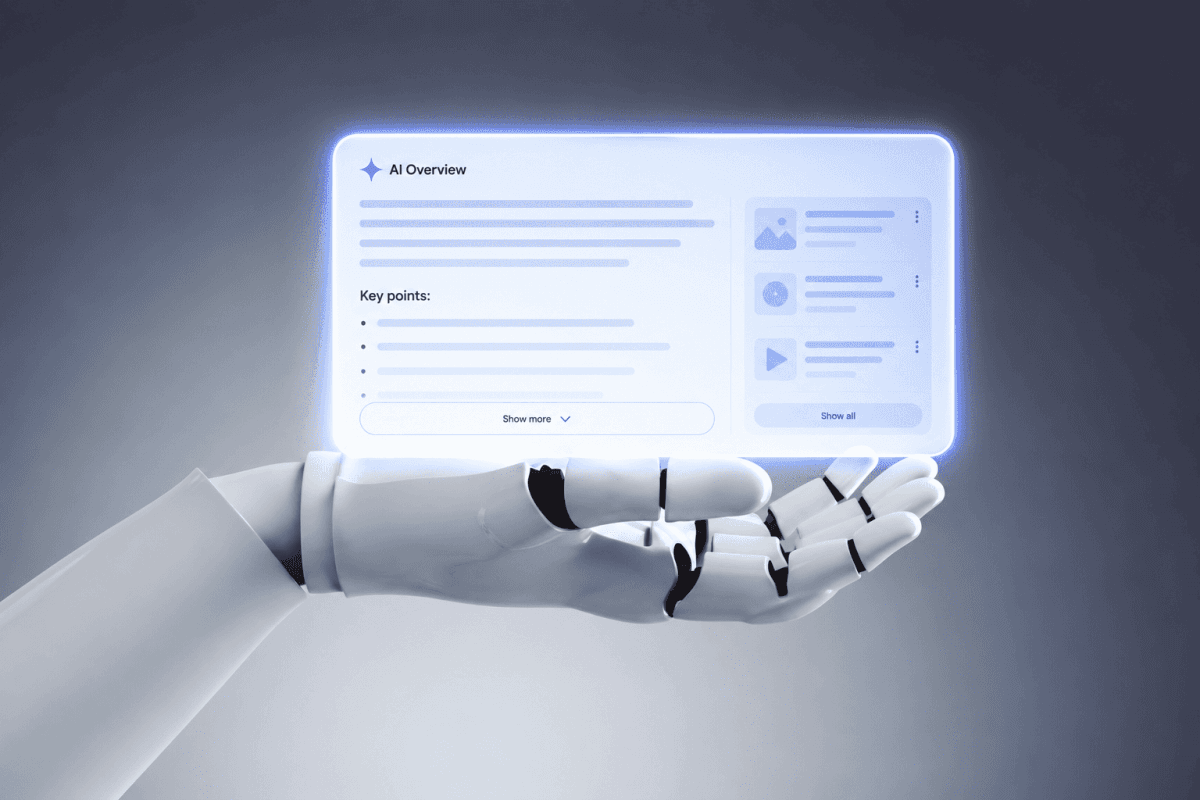
AI visibility is how often and how prominently a brand, website, product, or service appears in AI-generated answers. This can happen in a few different ways:
1. Brand mentions
A brand mention is when an AI platform names your business in its answer. For example:
“For businesses in Malaysia, Company A, Company B, and Company C are common options.”
Even without a link to your website, your brand has gained visibility.
2. AI citations
An AI citation is when an AI-generated answer uses your website or another source to support its information, often with a link.
Mentions and citations are not the same. Your business can be cited without being mentioned directly, or mentioned without your website being cited.
3. Brand representation
AI visibility is also about how AI systems describe your business.
This gives you an idea of how AI systems understand your brand. But being mentioned is not always a good thing if the information is outdated or inaccurate.
The goal is not simply to appear in AI answers. It is to be represented accurately and in the right context.
Functional Layers of AI Visibility
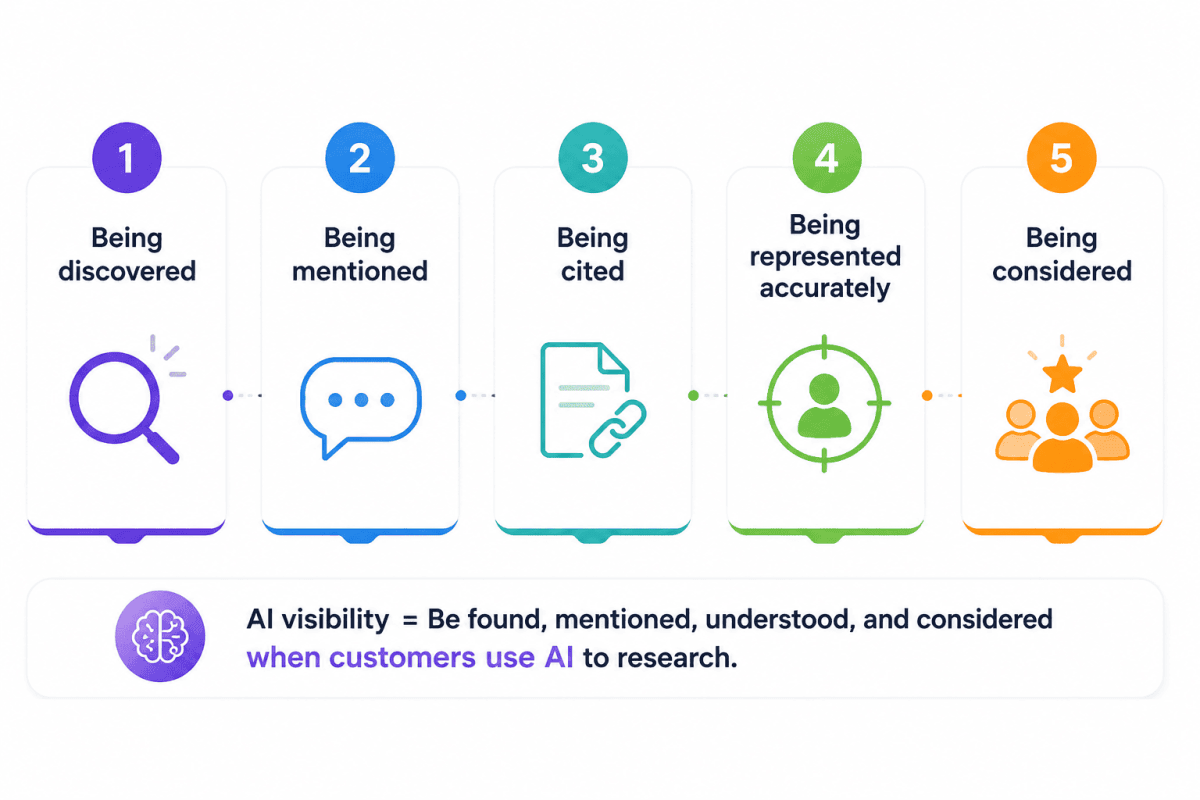
AI visibility works across several layers, each shaping how your business appears in AI search as your customers research their options. These layers include:
1. Being discovered
Your business needs to appear when people ask AI about topics, products, or services related to what you offer. An important consideration here is to ask yourself: Is your business showing up at all?
2. Being mentioned
The next step is getting your brand included in the answer. A mention puts your business in front of someone who may not have known about you before.
3. Being cited
AI may also use your website or other content as a source. A citation can help support the information in the answer and give users a way to explore your business further.
4. Being represented accurately
Visibility is only useful if the information is right. AI should understand what your business does, who you serve, where you operate, and what makes your offering relevant.
5. Being considered
The strongest form of visibility is when your business becomes part of the customer’s consideration set. You are not just appearing in an answer, but being seen as a relevant option alongside your competitors.
How Does AI Visibility Differ From Traditional SEO?
Traditional SEO and AI visibility work together, but they focus on different outcomes. Here is how the two compare:
| Traditional SEO | AI Visibility |
| Focuses on search rankings | Focuses on presence in AI-generated answers |
| Targets keywords and search queries | Targets questions, topics, entities and conversational prompts |
| Aims to rank individual pages | Aims to establish authority across a topic or category |
| Search results usually present multiple links | AI systems may synthesise information from multiple sources |
| CTR (click-through rate) is an important metric | A mention or citation can create value even without a click |
SEO is not being replaced. Google says its AI search features still rely on existing search systems, so foundational SEO practices remain important. Pages generally need to be indexed and eligible for Google Search to appear as supporting links in AI Overviews or AI Mode.
In practice, the two are increasingly being approached together. Many SEO service providers now integrate AI visibility into their broader search strategies rather than treating it as a separate discipline.
AI Visibility, AEO and GEO: What’s the Difference?
You will often see AI visibility, AEO, and GEO mentioned together because they all relate to how businesses appear in AI-powered search. They are closely connected, but they are not quite the same thing.
- • AEO, or Answer Engine Optimization: The practice of creating and structuring content so it can provide clear, useful answers to the questions people ask.
- • GEO, or Generative Engine Optimization: A broader approach to improving how your brand and content are understood and surfaced across generative AI platforms.
- • AI visibility: The outcome. It looks at how visible your brand is in AI-generated answers, including whether you are mentioned, cited, or recommended.
The terms can overlap, and there is no single definition used across the industry. A simple way to think about them is: AEO and GEO are approaches you can use to strengthen your AI presence, while AI visibility is how you measure the result.
Why Does AI Visibility Matter for Businesses in 2026?
1. Customers are changing how they research: People can now use AI to understand a problem, explore solutions, compare options, and narrow down their choices before visiting a website.
2. Your brand can be discovered without a direct search: Customers do not need to search for your company by name. Your business can appear when they ask questions related to the products, services, or problems you specialise in.
3. AI can influence the consideration stage: By the time someone reaches your website, AI may have already shaped their understanding of your industry and which businesses are worth considering.
4. Competitors can take your place: If your competitors consistently appear in relevant AI answers while your business does not, they may gain visibility during the research process before you have a chance to reach the customer.
5. Your brand reputation can extend beyond your website: AI systems can draw on information from different sources, so how your business is described across the wider web can influence how it is represented in AI answers.
6. AI visibility can support traditional SEO: The fundamentals of SEO still matter, but businesses can now look beyond rankings and clicks to see whether their content and brand are also being surfaced in AI-generated answers.
7. AI is becoming part of the Malaysian business landscape: AI adoption among Malaysian businesses is growing, making AI increasingly relevant to how companies operate, communicate, and reach customers. This does not mean every customer is already using AI search, but it shows why businesses should start paying attention to the shift.
8. It gives businesses another way to measure visibility: Rankings tell you where your pages appear in search. AI visibility adds other questions, such as whether your brand is mentioned, cited, recommended, or accurately represented.
Ultimately, AI visibility is not about replacing your existing digital strategy. It is about making sure your business remains visible as the way people search, research, and make decisions continues to evolve.
How Does AI Search Decide What to Include?

There is no single formula for what appears in an AI-generated answer. Different platforms use different systems and retrieval methods, so the same question can produce different results.
Google, for example, explains that its AI search features use query fan-out, gathering information from multiple related searches before generating an answer. This means AI visibility is not just about ranking one page for one keyword. An answer may draw from several pages and sources.
Several factors can influence whether your business and content are surfaced:
1. Content quality and relevance
Your content needs to answer the question clearly and provide genuine value. Pages created mainly to target keywords are less useful than content that directly addresses what people are looking for.
2. Topical authority
Being useful on one topic is not always enough. Building a wider body of relevant content can help demonstrate your expertise and give search systems a clearer understanding of what your business knows.
3. Clear business information
AI systems need to understand who you are and what you do. Keep important information about your business, services, expertise, and location clear and consistent across your website and relevant sources.
4. Third-party references
AI systems can draw information from sources beyond your website. Relevant industry publications, directories, reviews, partners, and other credible sources can therefore influence how your business is understood and represented.
5. Technical accessibility
Strong content still needs to be accessible to search systems. Your website should follow basic SEO practices that make important pages easy to crawl, index, understand, and navigate.
Common AI Visibility Mistakes

1. Treating AI visibility as a replacement for SEO
It is not. SEO remains important. Google’s current guidance specifically says its AI search experiences are built on existing Search systems and that foundational SEO practices remain relevant.
2. Creating content just for AI
Do not fill your website with hundreds of generic pages because you think AI needs more content.
More content is not automatically better. Create useful content that answers real questions and demonstrates genuine expertise.
3. Focusing only on your own website
AI systems can use information from many sources.
Your website matters, but so do reputable third-party references, reviews, publications, and other sources that discuss your brand.
4. Chasing mentions without checking accuracy
A brand mention is not automatically a good result.
If AI repeatedly associates your company with the wrong service, location, or market, you have a visibility problem of a different kind.
5. Measuring only traffic
AI search can influence customers before they ever visit your website.
A prospect may encounter your brand in an AI answer, remember it, and visit your website later through another channel. That makes attribution more complicated. Measure visibility alongside leads, conversions, branded search, and other business outcomes.
How to Improve AI Visibility
1. Start with what your customers are asking
Begin with your audience, not the AI platform. Think about the questions people ask when researching your products, services, or industry.
These questions can guide your content strategy and help you create pages that answer real customer needs.
2. Answer important questions clearly
Give readers the answer they are looking for without making them dig through the page.
If someone asks what a service does, explain it early. If they want to understand costs, give a useful range or the main factors that affect pricing.
Clear, direct answers are better for both readers and search systems.
3. Build depth around your key topics
Instead of publishing disconnected articles, build a group of useful content around the areas your business specialises in.
This helps establish depth and makes it easier for users and search systems to understand your expertise.
4. Keep your business information consistent
Make sure important information about your business is accurate across your website and relevant third-party sources.
Pay attention to details such as your services, location, products, certifications, and areas of expertise. The goal is not to copy the same information everywhere, but to make sure the facts are consistent.
5. Show real expertise
Generic content is easy to produce, but it does little to show why your business is worth trusting. Where possible, add insights that come from your actual experience.
This could include case studies, original research, project examples, expert opinions, data, or practical lessons from working with customers.
Google also cautions against using AI to produce large amounts of content without adding value. Content created primarily to manipulate search rankings can fall under its spam policies.
6. Get the technical foundations right
AI visibility does not replace technical SEO. Your important pages still need to be accessible, crawlable, indexable, and easy for search systems to understand.
7. Build credibility beyond your website
Your website is only part of your online presence. Relevant coverage, industry publications, professional associations, partner websites, expert interviews, and other credible sources can all help establish your business as a trusted source.
Focus on relevance and credibility, rather than trying to collect as many links or mentions as possible.
8. Keep people at the centre
The best approach to AI visibility is still to create content that people genuinely find useful.
Make your pages clear, easy to navigate, well structured, and supported by relevant information. When you focus on helping people first, you are also building the strong content and search foundations that AI visibility depends on.
Conclusion
AI visibility should not be treated as just another box to check. It is about making sure your business shows up when customers use AI to research, with accurate and trustworthy information shaping how they see your brand. The good news is, you do not need to start from scratch. Strong SEO foundations already provide the groundwork for building your business’s AI visibility.
Want to strengthen your visibility across search and AI? Contact us today. Our SEO, AEO, and GEO services are designed to help your business build a stronger online presence, reach the right audience, and stay visible as search continues to evolve.
Frequently Asked Questions
1. How can I increase AI visibility?
Start with the basics: create useful, original content, answer customer questions directly, build topical authority, maintain strong technical SEO, and keep your business information consistent across your website and relevant third-party sources.
It also helps to test the questions your customers might ask AI platforms. See where your brand appears, which competitors are mentioned, and which sources are being cited.
2. How can I check my AI visibility?
Start by creating a list of questions your customers are likely to ask and testing them across relevant AI platforms.
Check whether your brand is:
- • Mentioned
- • Cited
- • Recommended
- • Described accurately
- • Appearing ahead of competitors
3. What is a good AI visibility score?
There is no universal “good” score. Different AI visibility tools use different prompts, platforms, and scoring methods, so scores from different tools are not directly comparable.
A better approach is to establish your own baseline and track how your visibility changes over time using the same questions and methodology. Comparing your results with direct competitors can also give you useful context.
4. Does AI visibility replace traditional search rankings?
No. Traditional search visibility is still important, and AI search is developing alongside conventional search rather than simply replacing it.
Google’s current guidance confirms that SEO fundamentals remain relevant to its generative AI search features.
Think of AI visibility as another layer of your search strategy, not a replacement for SEO.
5. Does getting cited by AI mean my website will receive traffic?
Not necessarily. An AI citation can give your brand valuable exposure without generating a click, especially when the platform answers the user’s question directly.
However, a citation can also encourage someone to visit your website and learn more. That is why AI visibility should not be measured by traffic alone. Look at citations alongside referral traffic, engagement, leads, and conversions to understand their real business value.