What are the Benefits of Having a Blog in SEO?

Introduction
A website’s blog page is more than just a collection of articles. For a Malaysian business, it is a way to capture search demand that service pages alone cannot address, especially around buyer questions, comparisons, costs, timelines, and other topics potential customers research before making an inquiry.
As more businesses compete online, useful content has become an important part of SEO. The question is not whether you should publish more blog posts, but whether your website has enough valuable content to build visibility, trust, and authority. This guide explores the role of having a blog in SEO, the types of content that work, and what to look for in an SEO content writing service.
What is a Blog in SEO?
An SEO blog is a collection of content designed to attract relevant search traffic by answering the questions, concerns, and topics potential customers search for online.
Unlike service or product pages, blog content often targets informational and commercial-intent searches that occur earlier in the buying journey.
What is the Function of a Blog in SEO?
- • Expanding Search Visibility: Service pages focus on core offerings, while blog content helps businesses reach potential customers earlier in the buying journey, before they are ready to inquire.
- • Building Topical Authority: Consistently publishing useful content around related topics helps search engines understand what your website is about while building trust with potential customers.
- • Strengthening Internal Linking: Relevant articles can direct readers to service pages, product pages, case studies, and contact pages. Blog content is often easier to rank for informational searches, making it a valuable way to attract traffic and pass topical relevance and authority to key pages.
- • Answering Buyer Questions: Topics such as pricing, timelines, comparisons, processes, and frequently asked questions help potential customers make more informed decisions before contacting a business, reducing uncertainty and friction along the way.
- • Capturing Long-Tail Searches: Many valuable searches are highly specific. Blog content allows businesses to target detailed queries that may not fit naturally on service pages, creating additional opportunities to attract relevant traffic.
- • Supporting Enquiries and Conversions: By answering relevant questions and guiding readers towards appropriate next steps, blog content can help turn search traffic into enquiries while supporting long-term SEO performance.
Why Blogging Still Matters for SEO in 2026

Despite the rise of AI-assisted search, blogging remains an important part of SEO. Google’s AI optimization guide continues to emphasize creating helpful, people-first content. A strategic blog supports that goal in several ways:
1. Search Visibility and AI Citations
AI systems still rely on source content. When your website publishes clear, specific, and well-supported information, it has a greater chance of being referenced in AI-generated answers while continuing to attract high-intent search traffic.
This is becoming increasingly important as AI Overviews change how users interact with search results. Ranking alone is no longer enough. Content must be valuable enough to earn both visibility and citations.
2. Strong Rankings Still Matter
Although search is evolving, traditional rankings remain important. Research from Ahrefs found that about 76% of AI Overview citations came from pages already ranking in Google’s top search results.
For Malaysian businesses investing in SEO, the objective is no longer simply ranking for more keywords. The goal is to create content that can rank well, build credibility, earn citations, and demonstrate expertise before a potential customer makes contact.
3. Search Demand vs Social Media and Advertising
Social media and paid advertising can increase visibility, but they serve a different purpose from search. Social platforms often interrupt attention, while search captures existing intent from people actively looking for answers, products, or services.
A strategic blog helps businesses capture this demand by creating content around the questions potential customers are already asking. Unlike advertising, which stops generating visibility when spending ends, well-optimised content can continue attracting relevant traffic over time.
How Blog Content Supports the Customer Journey

A blog helps turn search traffic into enquiries by supporting customers at different stages of the decision-making process. From initial research to provider evaluation, the right content can answer questions, build trust, and guide readers towards taking the next step.
1. Awareness-Stage Content
Awareness content answers the initial questions people search when trying to understand a problem or explore a solution. These topics attract visitors who are actively researching, while providing opportunities to guide them towards relevant services, resources, or next steps as their interest develops.
2. Consideration-Stage Content
Consideration content helps potential customers evaluate their options and determine what best fits their needs. At this stage, readers are looking for more detailed information to compare solutions, understand differences, and address common concerns before making a decision. Relevant internal links can then guide them towards the next step, whether that is learning more about a service, viewing a case study, or making an enquiry.
3. Conversion-Focused Content
Conversion-focused content helps reduce uncertainty before an enquiry or purchase. Topics that address pricing, processes, timelines, deliverables, or common questions can help potential customers feel more confident about taking the next step. Rather than acting as a sales pitch, this content helps qualify interest and prepare readers for a conversation with the business.
4. Commercially Useful Content
Commercially useful content addresses the practical questions buyers ask when evaluating providers. Topics related to costs, scope, requirements, risks, compliance, or expected outcomes can help readers make more informed decisions. By providing useful information upfront, businesses can build trust while creating a natural path towards an enquiry or consultation.
Elements to Include for a Blog in SEO
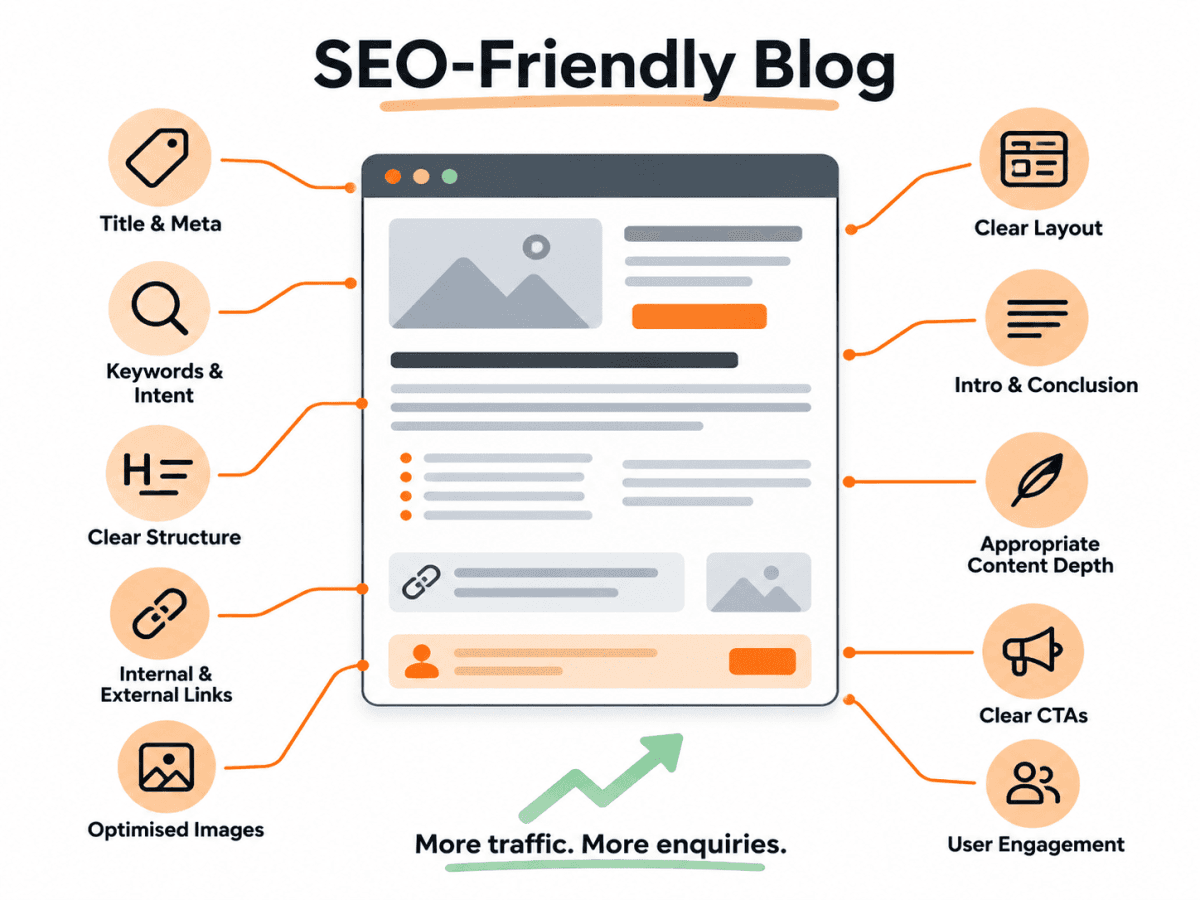
1. Title Tags and Meta Descriptions
Every blog post should have a unique title tag and meta description that accurately describe the content and encourage clicks from search results. While they are not direct ranking factors, they can improve click-through rates and help search engines understand the page.
2. Relevant Keywords and Search Intent
Every blog post should have a clear primary topic and search intent. While related keywords can be included naturally, the content should focus on answering one main search query rather than trying to rank for too many unrelated terms at once. This helps search engines better understand the page while making the content more useful and focused for readers.
3. Clear Heading Structure
Use a logical heading hierarchy with H1, H2, and H3 tags to organise content and improve readability. A clear structure helps readers navigate the article while making it easier for search engines to understand the page.
4. Internal and External Links
Include internal links to relevant service pages, case studies, and related articles, alongside external links to credible sources where appropriate. This helps users find additional information while strengthening topical relevance and trust.
5. Optimised Images
Images should support the content, load quickly, and include descriptive file names and alt text. Well-optimised images can improve user experience and contribute to image search visibility.
6. Clear Content Layout
Break content into short paragraphs, descriptive subheadings, bullet points, tables, and visuals where appropriate. A well-structured article is easier to scan, especially on mobile devices.
7. Intro and Conclusion Sections
The introduction should establish the article’s main topic and search intent early, helping both readers and search engines understand what the content covers. The conclusion should summarise the key points, reinforce the topic naturally, and guide readers towards a relevant next step.
8. Appropriate Content Depth
There is no ideal word count for SEO. The right length depends on the topic and search intent. Rather than targeting an arbitrary word count, focus on covering the subject thoroughly enough to answer the user’s question without unnecessary filler.
9. Clear Calls to Action (CTAs)
Every blog post should guide readers towards a logical next step. Depending on the topic and search intent, this could be a service page, consultation request, contact form, case study, product page, or related resource. Well-placed CTAs help turn informational content into business opportunities without disrupting the reading experience.
10. User Engagement
A well-structured blog should keep readers engaged long enough to consume the content and take the next step. Clear formatting, helpful information, relevant internal links, and a logical content flow can all contribute to stronger engagement signals and a better user experience.
How to Choose the Best SEO Provider for Blog Content
1. Audience Understanding
Effective SEO content starts with understanding the audience. A good agency should know who the content is for, what questions potential customers are asking, and where they are in the buying journey. Content that aligns with audience needs is far more likely to attract relevant traffic and enquiries.
2. Clear Goals and Content Objectives
Every blog post should support a specific objective, whether that is increasing visibility, educating prospects, building trust, supporting service pages, or generating enquiries. Without clear goals, content can quickly become a publishing exercise rather than a business asset.
3. Search Intent and Content Strategy
Every article should have a clear purpose. A good agency should be able to explain what search queries a topic targets, the intent behind those searches, and how the content fits into your wider SEO strategy. Publishing content consistently is important, but publishing the right content is what drives results.
4. Content Quality and Expertise
The most effective blog content combines SEO best practices with genuine subject knowledge. This is especially important in technical, regulated, or specialised industries where accuracy and credibility influence both user trust and search performance.
5. On-Page SEO and Content Optimisation
Creating the article is only part of the process. A strong SEO blogging service should also consider elements such as search intent alignment, heading structure, metadata, internal linking, schema opportunities, image optimisation, and content updates to maximise long-term value.
6. Content Maintenance and Updates
SEO content should not be treated as a one-time project. Search trends, industry information, competitor content, and customer expectations change over time. Regularly reviewing, refreshing, and expanding existing articles can help maintain relevance, improve accuracy, and extend the long-term value of your content.
Conclusion
A blog is still worth the investment for Malaysian businesses, but only if it works to capture demand and build trust, not just fill a content calendar. The strongest blog strategies answer the questions buyers already have before they enquire, link back to service pages to support them, and give Google and AI search tools something useful and relevant to show people.
At BrandSwift, we build blog and SEO content strategies that are mapped to real search intent and designed to move buyers closer to enquiry. Contact us today to find out how our SEO services can help your business get found by the right people.
Frequently Asked Questions
1. Are Blogs Really That Important for SEO?
Yes. Blogs help businesses target search queries that service and product pages cannot cover effectively on their own. They can improve topical authority, attract relevant search traffic, answer buyer questions, and support key pages through internal linking.
2. I Want a Minimalist Website. Do I Still Need a Blog?
Minimalist websites do not strictly need a traditional chronological blog for SEO, but they can still benefit from one. A blog provides space to answer customer questions, target additional search terms, and build topical authority without overcrowding core service pages.
The key is not whether the content sits under a “Blog” section, but whether your website provides enough useful information for potential customers and search engines to understand your expertise.
3. Does blogging still help SEO in 2026?
Yes, blogging still helps SEO in 2026, but only when the content is original, useful, and tied to real search intent. It now serves two jobs: ranking in organic search and becoming a source that AI-generated search answers may cite.
4. How long does it take for blog content to help SEO?
Some improvements can appear within weeks, but meaningful SEO gains often take several months as content gets crawled, indexed, linked internally, and recognized for relevance.
5. Can a small Malaysian business get SEO results from a blog without publishing every week?
Yes, a small Malaysian business can achieve SEO results from blogging without publishing every week. The key is focusing on high-intent topics, producing quality content, and keeping existing articles updated over time.